
Bolster pillow with piping
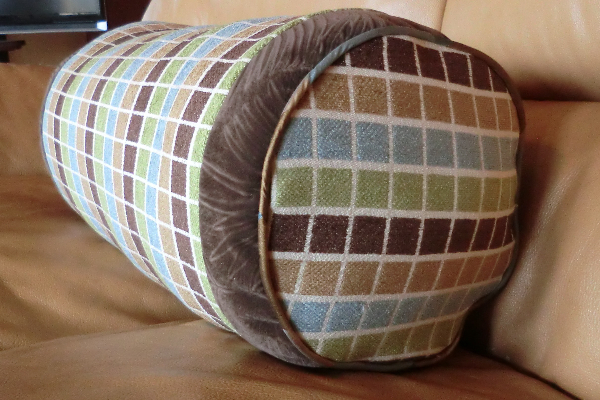 |
Bolster pillows are fun. They just are. When all the other pillows are square, they are round. When the other pillows look uptight and stiff, bolster pillows invite your neck to relax on them. They also always seem a little more complicated to me, but they are really easy to make. |
Supplies
(Click fabrics for direct links for purchase at Warehouse Fabrics Inc.)
|
|
|
|
|
|
|
|
||
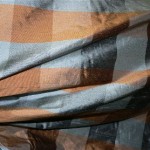
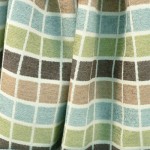
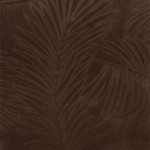
| I used they City Square Alabaster for my main fabric and had plenty with 1 yard. I had 1/3 yard of the chocolate contrast fabric. I used two 32″ pieces of piping cord and made my own piping. I used leftovers of a silk fabric (the Savannah Bluestone) to make the piping, figuring it would be easier to work with than the heavier pillow fabric and add a nice touch. Our piping tutorial can be found here. | |||
The pattern
 |
 |
||
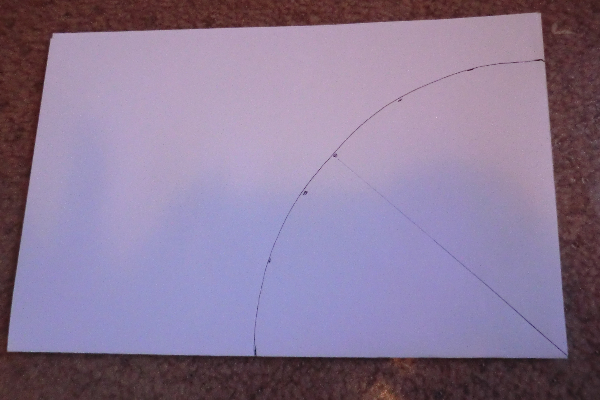
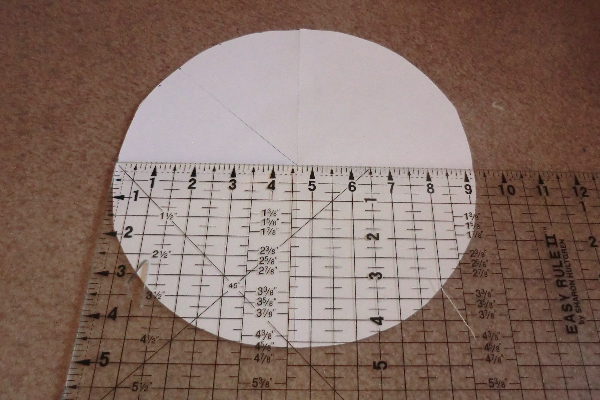
| (Click for bigger pictures)Cut one rectangle measuring 16″ x 30″ (the 16″ is the width, so think of that if your pattern is directional) from your main fabric. Cut two rectangles measuring 3.5″ x 30″ for your contrast fabrics. (The 3.5″ is the width.) Cut two circles with a diameter of 9.25″ out of your main fabric. See the photos above on making a perfect circle. You simply take a piece of paper and fold it in half twice. Then, from the folded corner, measure the RADIUS (half the diameter) from that corner and make little marks, forming an arc. Then trace across and cut along that line. When you unfold it, you will have a nice, even circle the diameter that you wanted. In this case, my radius while drawing my arc was a little more than 4.5″. (Mix up fabrics as you please. This is how I did mine. You can use three different fabrics or just two. You can do the ends from the contrast fabric. It’s entirely up to you. I used a silk fabric in my stash to make my piping. You can use one of your pillow fabrics if you want.)
If you want your pillow in different dimensions, how do you calculate the circle size? At first I was thinking, “I wish there was some mathematical way to do this!” Then I thought, “Duh. There is.” Circumference = the length of the sides of your fabric, which will form a circle in the end. For this example that’s 30″, but after the seams are sewn, it’s 29″. Diameter = Circumference/Pi Just sub in your own numbers to calculate yours. Isn’t math fun and useful? |
|||
The process
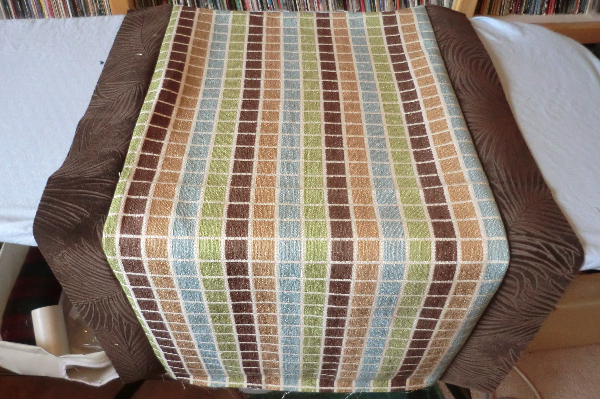 |
First, sew the long seams of your fabrics together as shown. |
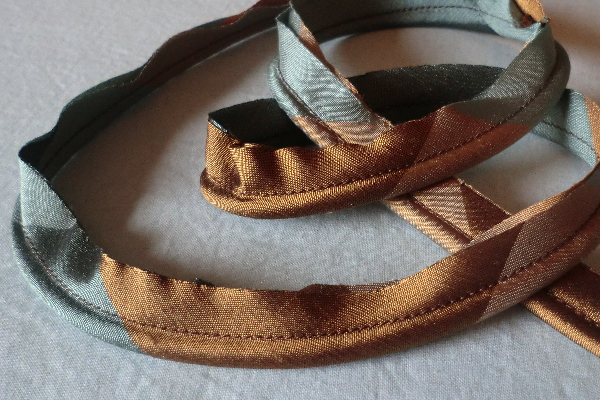 |
Next, make your piping. We have a piping tutorial if you need a hand. Trust me, it’s easy!I used a silk fabric I had leftover from another project. It might look like it doesn’t match that great, but it looked fantastic once it was all put together! |
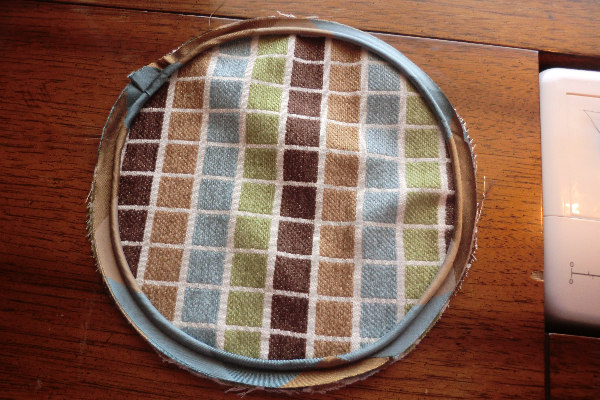 |
Sew your piping around each circle. To join the ends beautifully, see this tutorial. |
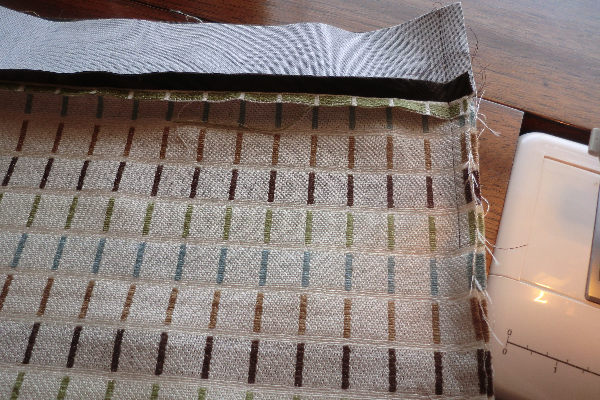 |
Now fold your fabric so the short ends are together (and your contrast fabrics are still on either side. Sew a 1/2″ seam, leaving a hole in the middle big enough to turn the pillow and reach your hand in so you can stuff it later.Remember to make sure those seams where the two different fabrics meet line up perfectly when you pin it and sew it. |
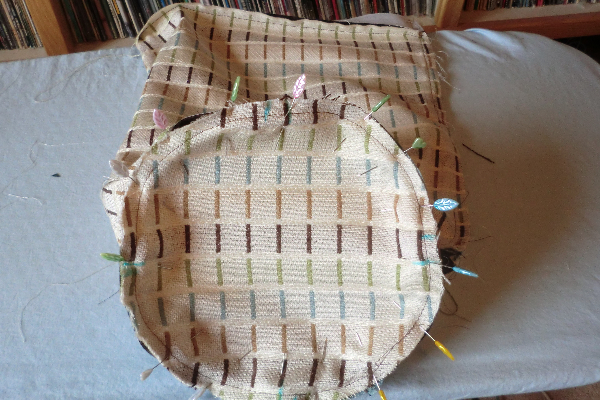 |
Pin your circle to the end. The best way to do this is to mark your pillow and your circle in quarters by folding and marking with a fabric pen or chalk. Then fold the other way and do the same. Now you have marks at 12 o’clock, 3 o’clock, 6 and 9. Line those up and pin, then distribute the fabric between the pins evenly and pin all around.Note that if you have a directional fabric, you might want to be careful here. I have stripes, essentially (stripes made of squares), so I want the lines to run in the same direction as the pillow’s lines. If it was slightly off kilter, it wouldn’t look as good. |
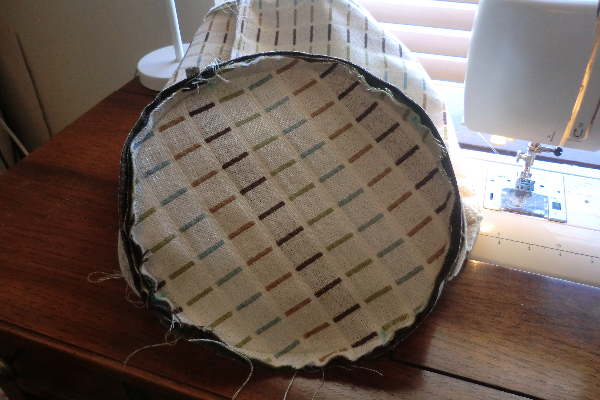 |
Sew all the way around. I prefer to use a piping foot (remember, there’s piping under there). You’re going for a 1/2 inch seam allowance, but just follow close to the piping. |
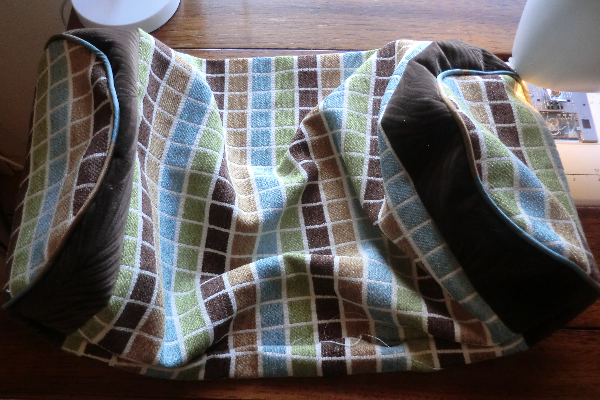 |
Turn right-side out through that hole you left. |
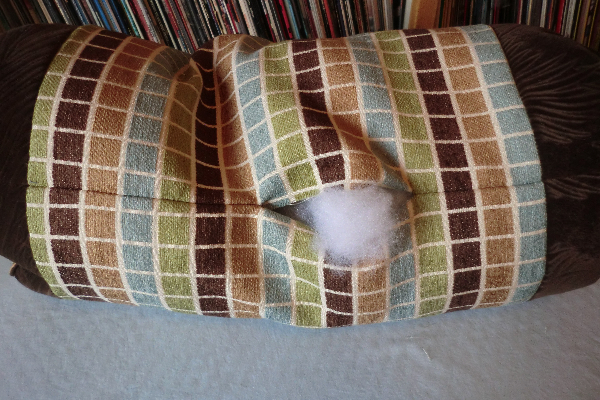 |
Stuff with stuffing. |
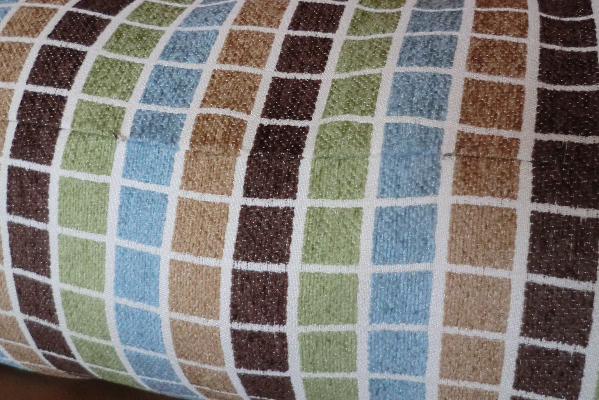 |
Slip stitch that hole closed. The fact that my vertical lines of squares matched up perfectly was pretty much a miracle. Somehow, when I was sewing my seam from the other side, I forgot to even think about this. I simply lined up the seams where this fabric and the brown fabric met. If I’d tried to make these line up, surely they wouldn’t have in the end! |
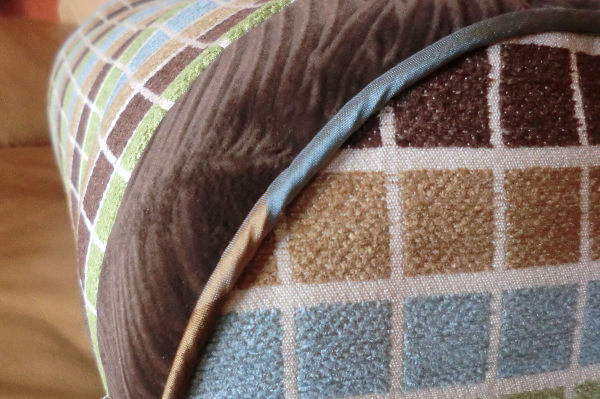
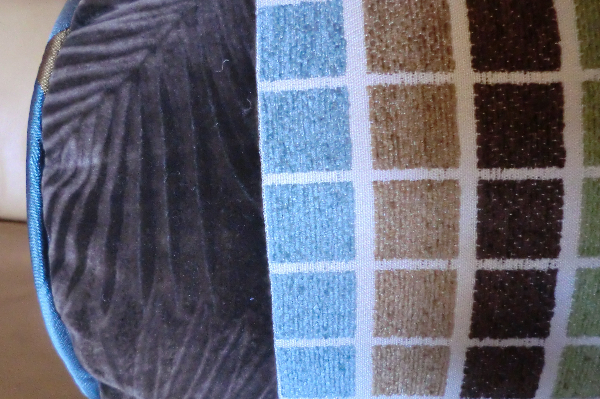
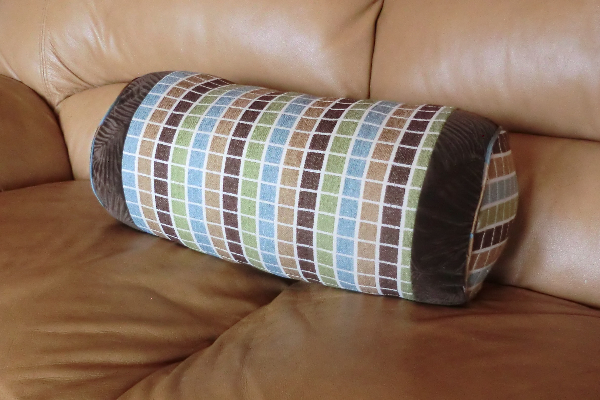
Other views
(Click for bigger views)
 |
 |
 |


